






Moleaer Patents Nanobubble Process for Polymer Activation That Cuts Polymer Use and Operating Costs, Including Hauling and Disposal
Nanobubble process reduces polymer consumption by 10-40%, improves cake solids resulting in lower operating costs at wastewater treatment plants
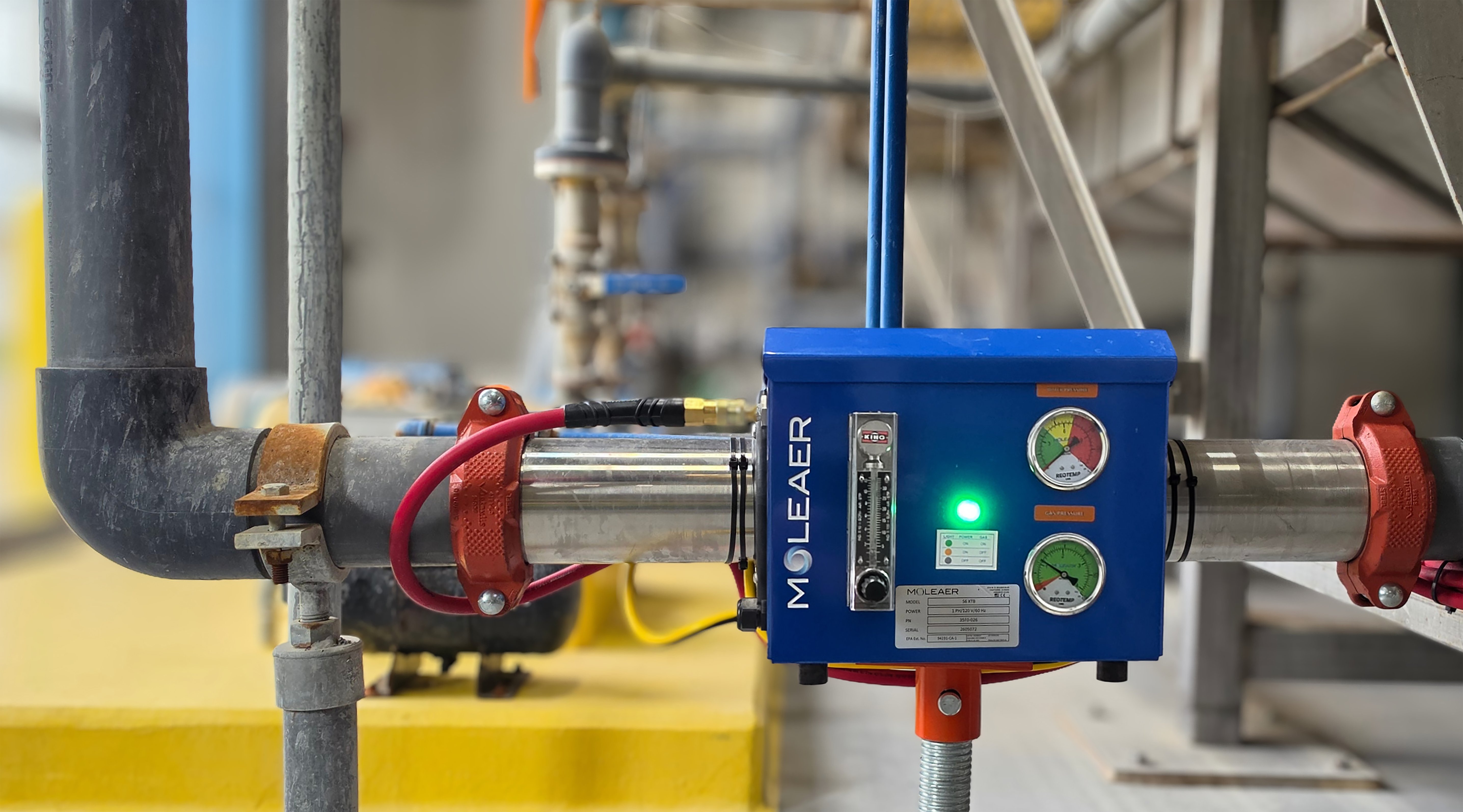
September 9, 2026 – Polymer and sludge hauling are among the largest controllable operating expenses at wastewater treatment plants. A newly patented nanobubble process from Moleaer, the global leader in nanobubble technology, is helping utilities reduce both by improving polymer performance during dewatering.
The patented process introduces nanobubbles into polymer makedown water before polymer blending, improving the performance of existing polymers without changing polymer chemistry or modifying existing dewatering equipment. The result is more effective polymer activation that operators can put toward lower polymer consumption, drier solids and reduced hauling costs, or a balance of the two.
Moleaer’s solution eliminates treatment process and financial risks, two key barriers to adoption. The nanobubble generator installs on the makedown water line with no moving parts, no interruption to operations, and no change to the treatment process. The solution is offered through a performance contract, so customers pay only for results.
"Polymer is one of the largest controllable costs in wastewater treatment, and traditionally, optimization has focused largely on polymer selection and chemistry along with equipment tuning,” said Nick Dyner, CEO of Moleaer. "We took a different approach by making the polymers that utilities and industries already trust perform better. It gives operators another way to reduce operating costs without requiring new dewatering equipment or changing their existing process."
Moleaer's patented process is used at municipal and industrial wastewater treatment facilities operating centrifuges, belt filter presses, screw presses and dissolved air flotation (DAF) systems. Nanobubble-enriched makedown water activates polymer more consistently, driving stability and predictability plants need to optimize performance downstream. Operators can optimize the process around the needs of their facility, whether the priority is reducing polymer consumption, producing drier cake solids or balancing the two for the best overall economics.
At Clean Water Services' Rock Creek Water Resource Recovery Facility in Hillsboro, Oregon, the utility could achieve either a 23% reduction in polymer use, or a 2-percentage-point increase in cake dryness (from 21% to 23%). It optimized total economics, settling on a 17% reduction with slightly drier cake, the balance that delivered its largest cost savings.
"Working with Moleaer's nanobubble technology has allowed us to meaningfully reduce our polymer consumption in biosolids production,” said Chris Maher, Senior Operations Analyst at Clean Water Services. “Of course this results in operational cost savings, but when we reduce our chemical consumption, we improve our carbon balance and increase our operational and financial resiliency, especially in a polymer market heavily influenced by petroleum markets. This is a simple and elegant technology emerging at just the right time. It's been a great partnership and a terrific example of innovation improving how we operate."
At Greer Commission of Public Work’s Maple Creek Wastewater Treatment Plant in South Carolina, nanobubbles were added to polymer makeup water during residuals thickening and dewatering operations. Greer saw that polymer consumption could be reduced by 30% while maintaining the same cake solids. With a fixed polymer feed rate and varying nanobubble doses, cake solids increased by 2 to 4 percentage points, depending on the type and concentration of polymer used.
“We saw that nanobubbles can improve residuals thickening and dewatering performance while reducing polymer consumption,” said Daniel Fahr, Wastewater Operations Manager at Greer CPW. “The results so far show that nanobubbles, when applied correctly, can be a valuable addition to thickening and dewatering operations at wastewater treatment plants.”
Moleaer’s enhanced polymer activation is compatible with dewatering and thickening systems across municipal and industrial wastewater treatment facilities. Since launching, it has become the fastest selling nanobubble application Moleaer has introduced.
About Moleaer
Moleaer is the leader in nanobubble technology, unlocking scalable, sustainable solutions that improve efficiency, increase productivity, and reduce water, energy and chemical use across industries. With more than 10,000 systems deployed in over 55 countries, Moleaer’s patented nanobubble generators deliver the most efficient gas-to-liquid transfer and nanobubble production available, accelerating physical, chemical and biological processes across a range of applications.
From agriculture and aquaculture to food safety, wastewater treatment, lake and reservoir restoration, natural resource recovery, and more, Moleaer’s technology is trusted to deliver better results with fewer inputs. By working with customers to solve their toughest challenges, Moleaer enables them to do more with less, sustainably, efficiently, and at scale. Learn more at www.moleaer.com.
