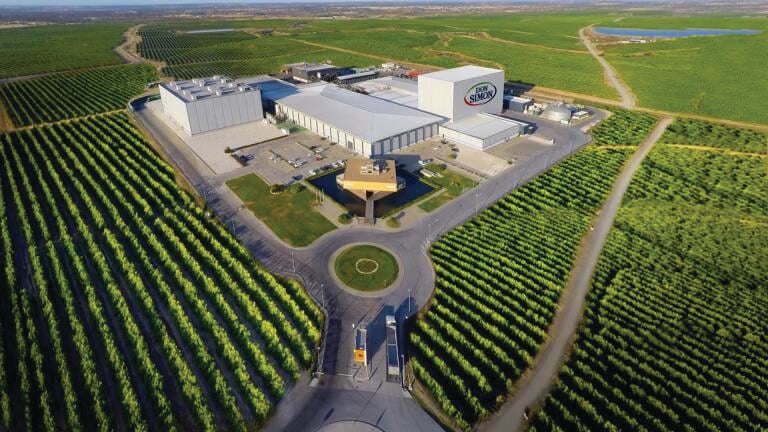






Citrus production across southern Spain runs on saline groundwater — and salinity is a structural constraint, not a seasonal one. Sodium and chloride accumulate in plant tissue, causing leaf chlorosis and necrosis, reduced tree vigor, and suppressed nutrient uptake. Chloride directly competes with nitrate, potassium, and calcium, capping output even in well-managed groves.
The same water degrades the irrigation system itself. Biofilm and suspended solids build up at dripper outlets, reducing distribution uniformity and driving up maintenance requirements. For Cítricos del Andévalo, both the plant and the system were paying the price.
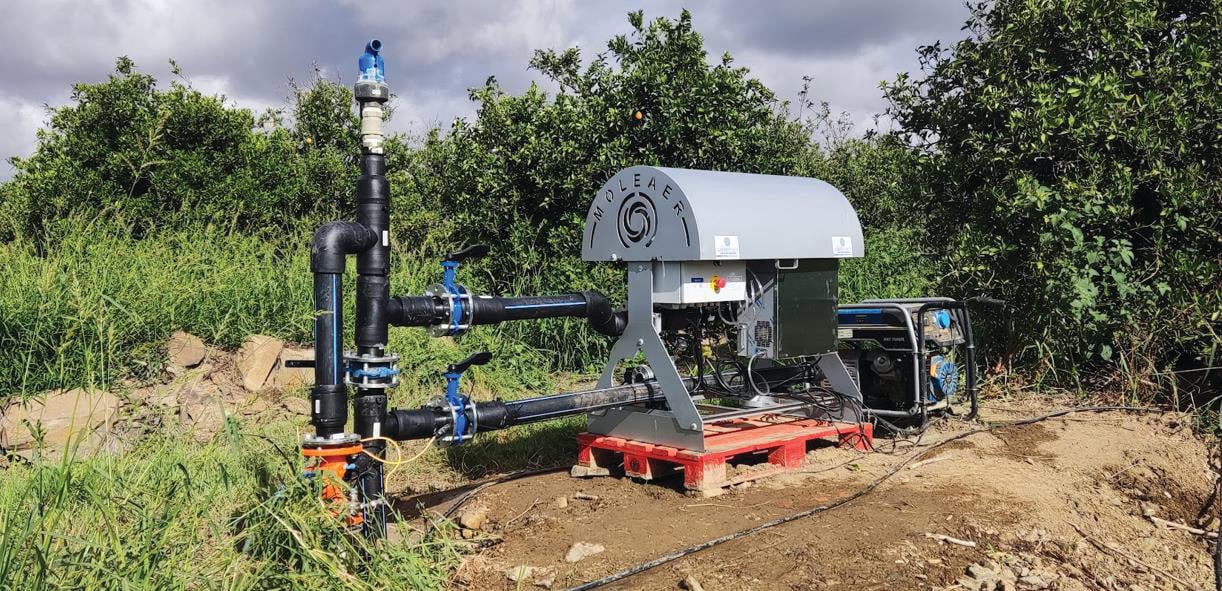
In June 2024, a Moleaer Indalo nanobubble generator was installed on a 3.2-hectare trial sector, injecting 90% pure oxygen into the irrigation line at 32 m³/h. An adjacent sector of the same variety, age, and management served as the untreated control. Foliar samples, dissolved oxygen, conductivity, and ORP were measured across three time points through January 2025.
Nanobubbles introduce oxygen as sub-200-nanometer bubbles that remain suspended through the entire distribution system — traveling through drip lines, disrupting biofilm at the emitter level, and delivering oxygen in dissolved, bioavailable form directly to the root zone.
Leaf chloride: Across all sampling dates, leaves in the treated sector showed chloride concentrations 4 to 6 times lower than the untreated control — reduced to roughly one-quarter of control levels. Better root-zone oxygen shifts how dissolved ions move through the soil-plant system, supporting salt leaching below the active root zone and reducing passive chloride uptake.
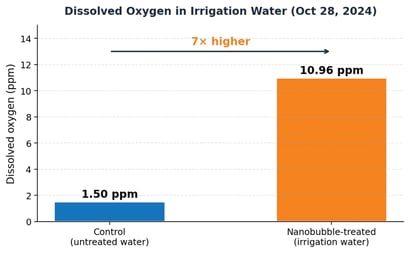
Oxygen at the root zone: Dissolved oxygen at the dripper outlets reached 10.96 ppm in the treated sector, compared to 1.5 ppm in the control — a 7× increase. ORP also shifted into a more oxidative range, supporting root respiration and nutrient uptake under stress conditions.
Irrigation system performance: Suspended solids at dripper outlets were significantly lower in the treated sector, indicating reduced biofilm accumulation within the lines. The practical outcome: improved distribution uniformity, less manual flushing, and more stable system performance over time.
Visible plant response: Within three months, the treated parcel showed a denser canopy and more uniform growth. By January 2025, treated trees carried a significantly heavier fruit load than the adjacent untreated control.
Conventional approaches to salinity — additional leaching, soil amendments, varietal changes — require more inputs and don't change how water behaves within the system. Nanobubble-treated irrigation does. At Cítricos del Andévalo, a single system-level change shifted both water chemistry and plant condition, delivering measurable results across the grove and inside the irrigation infrastructure.
For citrus growers operating on saline groundwater, nanobubbles offer a practical, system-level lever — applied at the irrigation headworks, with effects that reach the root zone and beyond.
Download Now