





Watch the video to learn how Greer addressed the root cause of foam rather than continuously treating the symptoms.
Key Takeaways:
- Eliminated defoaming chemicals within weeks of startup
- Eliminated settling chemicals shortly thereafter
- Maintained plant compliance, including during peak loading periods
- Generated an estimated $210,000–$290,000 in annual savings
- Required no permanent infrastructure modifications
The Greer Case Study: Nanobubble Technology in Wastewater preTreatment
Greer CPW, the public utility serving Greer, South Carolina, operates a wastewater treatment plant handling approximately 3 million gallons per day. The plant serves both residential customers and a significant base of industrial users.
The Problem: Surfactant-Driven Foam in a 3 MGD Municipal Plant
Industrial users discharge surfactant-rich wastewater, the soap-like compounds found in detergents and industrial cleaning products, that resist biological breakdown. In Greer's equalization basin, these surfactants generated persistent foam, at times more than two feet deep. Loading intensified during certain industrial production cycles, but the underlying challenge was continuous.
To keep the plant running, operators added defoaming chemicals to suppress foam, then aluminum sulfate and polymer to compensate for the destabilized biology downstream. Chemical spending climbed as high as $2,500 per day during peak loading. The approach worked, but it treated the symptoms, not the source.
The Solution: Moleaer Nanobubble Technology
Working with Xylem and Black & Veatch, Greer CPW deployed Moleaer nanobubble technology to target the surfactants directly.
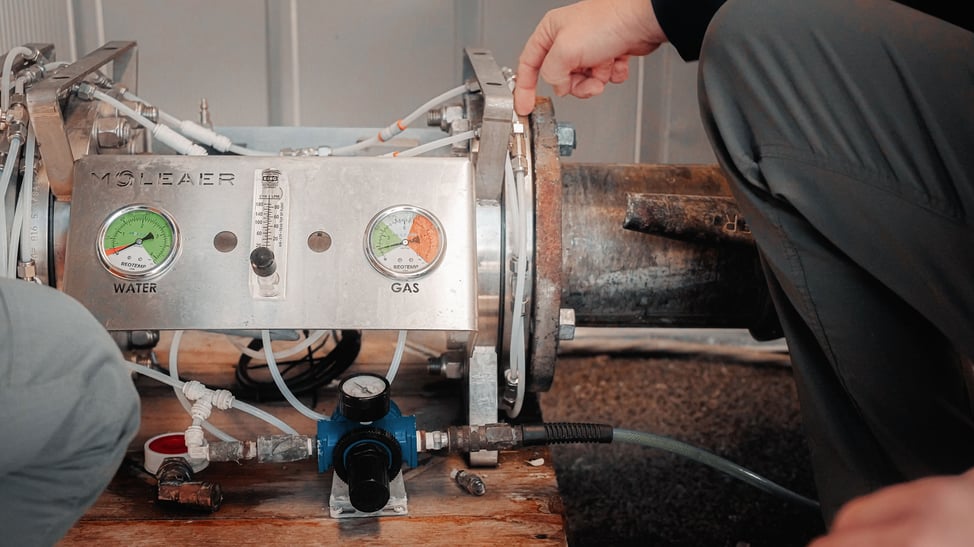
The installation was minimal: a Moleaer nanobubble generator, pump, and air compressor, pumping water from the equalization basin through the system, and returning it to the basin. No modifications to existing infrastructure were required.
The Results
Savings came from three sources: reduced chemical purchases, lower energy demand, and fewer solids requiring disposal. Greer CPW's results demonstrate what's possible when treatment targets the root cause.
| METRIC | OUTCOME |
| Defoaming Chemicals | Eliminated within weeks of startup |
| Settling chemicals | Eliminated shortly after |
| Plant compliance | Maintained throughout, including peak loading events |
| Estimated annual savings | $210,000-$290,000 |
Frequently Asked Questions
What is nanobubble technology in wastewater treatment?
Nanobubble technology in wastewater treatment uses gas bubbles smaller than 200 nanometers, roughly 2,500 times smaller than a grain of salt, to improve treatment performance. Because nanobubbles remain suspended in water for extended periods rather than rising to the surface, they can interact with contaminants like surfactants and reduce the load on downstream treatment processes.
What causes foam in wastewater treatment plants?
Foam in wastewater treatment is most commonly caused by surfactants, compounds found in residential and industrial detergents, cleaning products, and process chemicals used by manufacturing facilities. When surfactant-rich wastewater enters an aeration basin, the mechanical energy of the aeration process whips the surfactants into persistent foam that accumulates on tank surfaces and interferes with biological treatment.
How do nanobubbles reduce foam in wastewater?
Nanobubbles remain suspended in the water column far longer than conventional aeration bubbles, allowing for extended contact with contaminants. Their unique surface properties enable them to attract and concentrate surfactants, disrupting the bonds that hold foam-forming structures together before they reach downstream treatment stages. This addresses the root cause rather than suppressing foam after it forms.
Can nanobubble technology replace conventional aeration?
Nanobubble systems do not function as aeration equipment and do not replace blowers, diffusers, or aeration basins. They are applied as a pretreatment or process-intensification step that improves wastewater treatability and reduces biological and process stress, allowing downstream treatment systems to operate more effectively. Nanobubbles are not intended to supply process oxygen or serve as an aeration technology for wastewater treatment.
How quickly do nanobubbles work in a wastewater application?
At Greer CPW, foam levels began dropping within weeks of the system starting up, and operators were able to eliminate defoaming chemicals shortly after. Results will vary based on influent characteristics, flow rates, and loading conditions, but the Greer project demonstrated measurable impact within the first operating month.
What is the ROI of nanobubble technology for wastewater treatment?
At Greer CPW, the estimated annual return was $210,000-$290,000 from reduced chemical use, lower energy demand, and fewer solids requiring disposal. The pilot required no capital expenditure on permanent infrastructure. For utilities spending heavily on defoaming and settling chemicals, the payback period can be rapid.
Who are Moleaer's partners on the Greer CPW project?
The Greer pilot was a collaboration between Moleaer (nanobubble technology), Xylem (technology partner through the Xylem Innovation Labs accelerator program), and Black & Veatch (engineering design, integration, and monitoring). Xylem has published the full case study on the Xylem's Making Waves blog.
Is your facility dealing with foaming, high chemical dependency, or complex industrial influent? Talk to a Moleaer about your Plant
Case study conducted in partnership with Xylem and Black & Veatch. Full results published on Xylem's Making Waves blog.

